
Theorem Proving in Industry with Lean

zlib in Lean
A general-purpose AI autonomously converted zlib (C compression library) to Lean, passed the test suite, and proved the code correct
theorem zlib_decompressSingle_compress (data : ByteArray) (level : UInt8)
    (maxOutputSize : Nat) (hsize : data.size ≤ maxOutputSize) :
  ZlibDecode.decompressSingle (ZlibEncode.compress data level) maxOutputSize =
  .ok data
Blog post: When AI Writes the World's Software, Who Verifies It?
What is Lean?
A programming language and a proof assistant
Same language for code and proofs
Lean is implemented in Lean, enabling unprecedented extensibility
Lean is scalable
Lean has a small trusted kernel
Multiple Independent Kernels
-
The reference kernel (C++)
-
nanoda(Rust) -
lean4lean(Lean) -
nanobruijn(Rust) -
and more
arena.lean-lang.org hosts independent kernel implementations
Anyone can build a kernel and submit it
Disagreement between independent kernels exposes bugs that neither would catch alone
The State of Lean
250,000+ unique installations: VS Code (143K) + Open VSX (107K)
9,000+ GitHub repositories depending on Lean
Industry: AWS, Google, Microsoft, Mistral, Nethermind, Galois, others
Lean Beginnings
How did we get here?
Before Lean, there was Z3
Z3 is a state-of-the-art SMT solver created by Leonardo de Moura
Z3 powered bug-finding pipelines at Microsoft, catching thousands of defects
But for whole-program verification, proofs were too brittle: minor code edits broke solver traces
Leo started the Lean project in 2013, aimed at merging interactive and automated theorem proving
Focus on classical logic from the start, collaboration with Jeremy Avigad (CMU) on math library
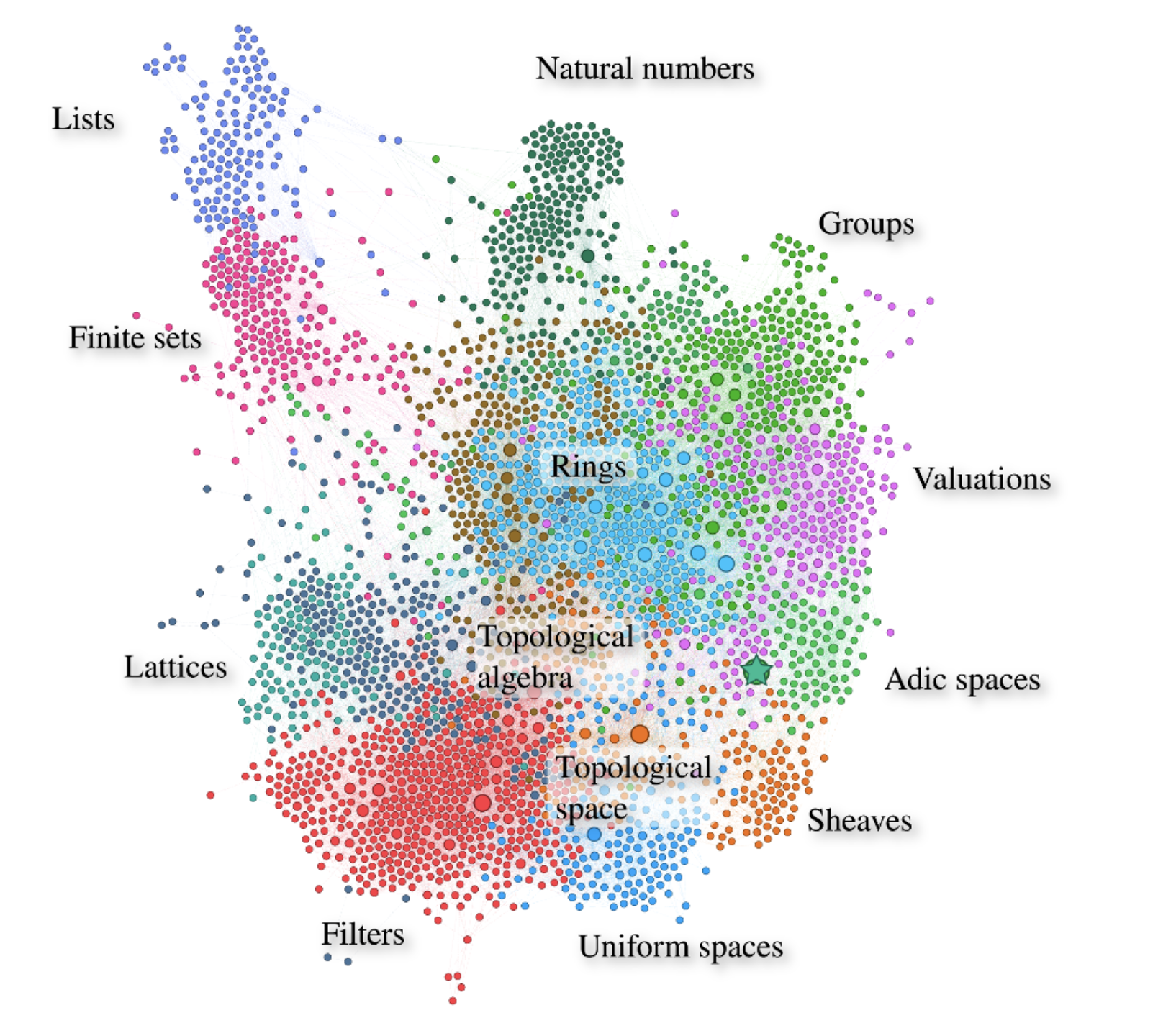
Mathlib: 2.2M+ Lines of Formalized Mathematics
270,000+ formalized theorems by 750+ contributors
An unprecedented community achievement
The Liquid Tensor Experiment
In 2020, Peter Scholze posed a formalization challenge
"I spent much of 2019 obsessed with the proof of this theorem, almost getting crazy over it. I still have some small lingering doubts." — Peter Scholze
Johan Commelin led a team that verified the proof, with only minor corrections
They verified and simplified it without fully understanding the proof. Lean was a guide
"The Lean Proof Assistant was really that: an assistant in navigating through the thick jungle that this proof is." — Peter Scholze
Lean Is Taking Mathematics by Storm
Six Fields Medalists engaged: Tao, Scholze, Viazovska, Gowers, Hairer, Freedman
-
Carleson's Theorem (completed) — van Doorn
-
Liquid Tensor Experiment (completed) — Commelin
-
Equational Theories Project (completed) — Tao
-
Sphere Packing — Birkbeck, Hariharan, Lee, Ma, Mehta, Viazovska
-
Fermat's Last Theorem — Buzzard
-
Inter-Universal Teichmüller Theory — Mochizuki
AI startups
"Lean has become the de facto choice for AI-based systems of mathematical reasoning." — ACM SIGPLAN Programming Languages Software Award 2025
Software Verification
Lean is not only for mathematics.
SampCert (AWS): Verified Differential Privacy
Differential privacy is the gold standard for privacy-preserving data analysis. Implementing it correctly is hard
Mironov's attack exploited floating-point to break DP. Bugs in random number generation have destroyed privacy guarantees in real systems
SampCert (Jean-Baptiste Tristan): the first comprehensive, mechanized foundation for executable DP implementations
-
12,000+ lines of Lean proof
-
Discrete Laplace and Gaussian samplers, proved correct using Fourier analysis and the Poisson summation formula from Mathlib
SampCert — Deployed at AWS
Custom code extractor: the deployed artifact does not go through the Lean compiler. TCB includes the extractor, not the compiler
Performance: SampCert outperforms diffprivlib by >2× for discrete Gaussians
Deployed in AWS Clean Rooms Differential Privacy
PLDI 2025: "Verified Foundations for Differential Privacy."
SymCrypt (Microsoft): Verified Cryptography
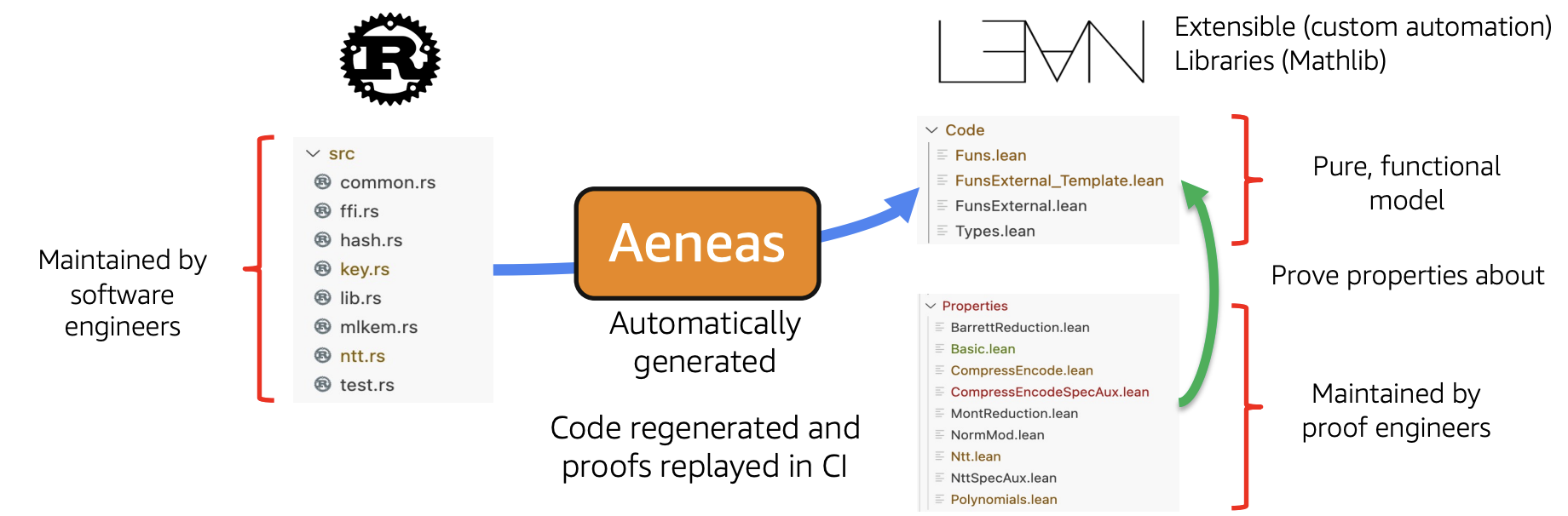
SymCrypt — Microsoft's core cryptographic library, rewritten in Rust
Aeneas translates safe Rust to pure functional Lean code. The bridge that makes Rust verification in Lean practical
SymCrypt — Verifying Code as Engineers Write It
They verify the Rust code as written by software engineers. No special verification-friendly subset
Code is evolving: new optimizations for specific hardware (AVX-512, Arm NEON, …). Proofs adapt to rewrites
"We are verifying code faster than we can write it." — Son Ho, SymCrypt, Microsoft
Anneal (Google): Verified Unsafe Rust
Google's zerocopy team building "literate verification" for unsafe Rust using Lean and Aeneas
Unsafe Rust accounts for ~2/3 of vulnerabilities in the Rust ecosystem. Safety invariants are documented only in prose comments
Anneal: developers write Lean specifications directly in Rust doc comments
-
specblocks for safe code -
unsafe(axiom)blocks for opaque unsafe operations with pre/post conditions -
Type invariants for struct safety properties
Designed for AI agents. Antigravity demonstrated authoring unsafe Rust and proving its soundness
Move Borrow Checker
Ilya Sergey (NUS) formalized and verified the borrow checker of Move (smart contract language) in Lean
39,000 lines of mechanized metatheory
Claude (Opus 4.5/4.6) handled proof repair, pattern propagation, routine preservation cases
Human insight still needed for novel proof strategies (e.g., weakening lemmas, inter-procedural reasoning for function calls took two days)
27 working days. Estimated 5-6 months without AI
Blog post: Verifying Move Borrow Checker in Lean: an Experiment in AI-Assisted PL Metatheory
CSLib: A Mathlib for Computer Science
CSLib aims to be a foundation for teaching, research, and new verification efforts, including AI-assisted
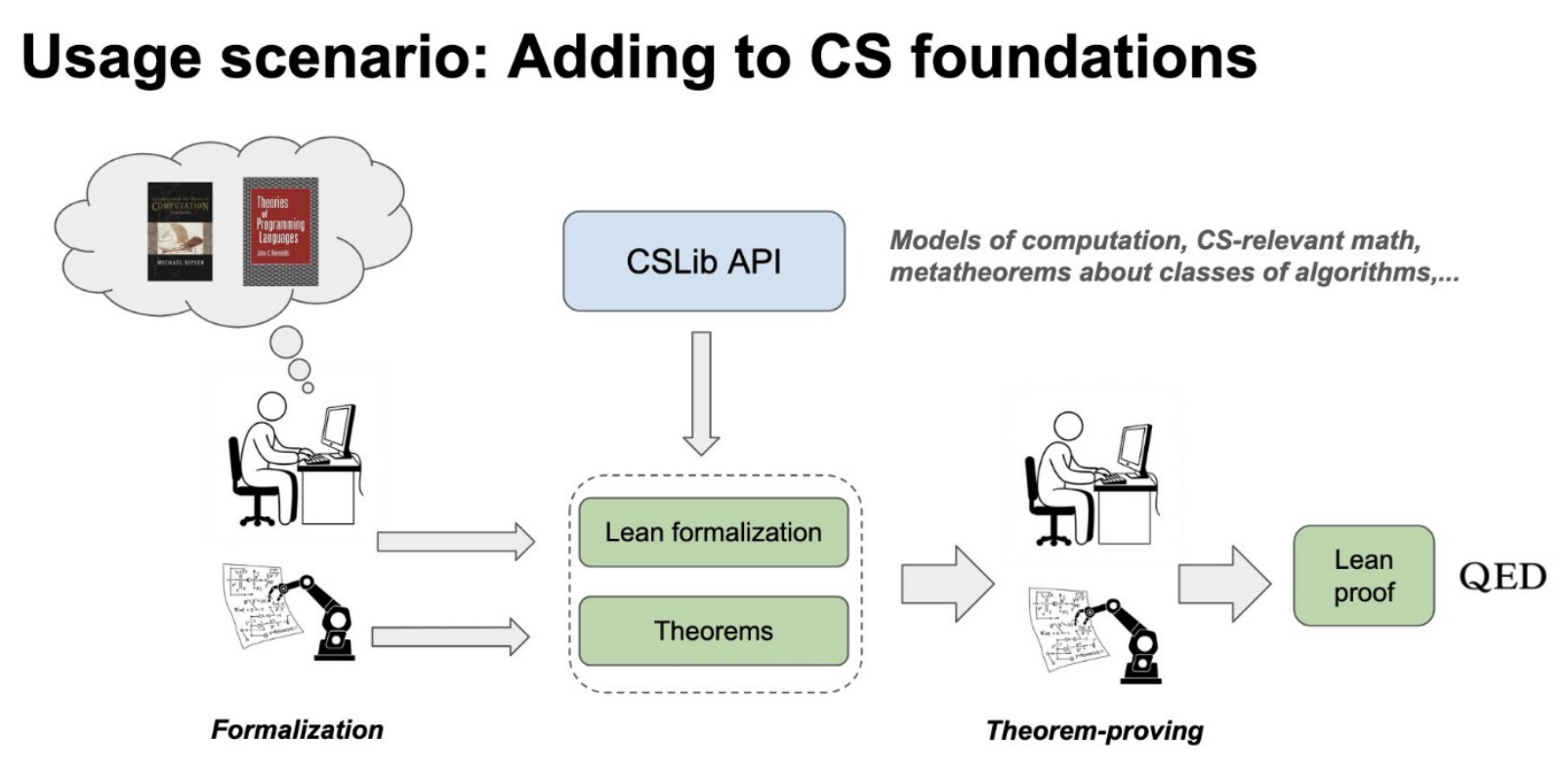
Steering committee: Clark Barrett (Stanford/Amazon), Swarat Chaudhuri (Deepmind/Austin), Jim Grundy (Amazon), Pushmeet Kohli (Deepmind), Leo de Moura (Lean FRO/Amazon), Fabrizio Montesi (U of Southern Denmark)
Signal Shot
Signal Shot is a public moonshot to verify the Signal protocol and its Rust implementation using Lean
It is a joint effort of Signal (Rolfe Schmidt), the Beneficial AI Foundation (Max Tegmark), and the Lean FRO
The pieces:
-
Aeneas,
-
Mathlib and CSLib,
-
Symbolic proof automation (
grind) and scalable verification generation (SymM), -
and AI
Proof Automation
The "classic AI" part of scaling up program verification.
Do We Still Need Proof Automation?
"I thought AI would prove all theorems for us now."
-
Tactics are like game moves
-
Better tactics = shorter proofs
-
Better tactics = more powerful AI
-
Compact proofs = better training data = better AI provers
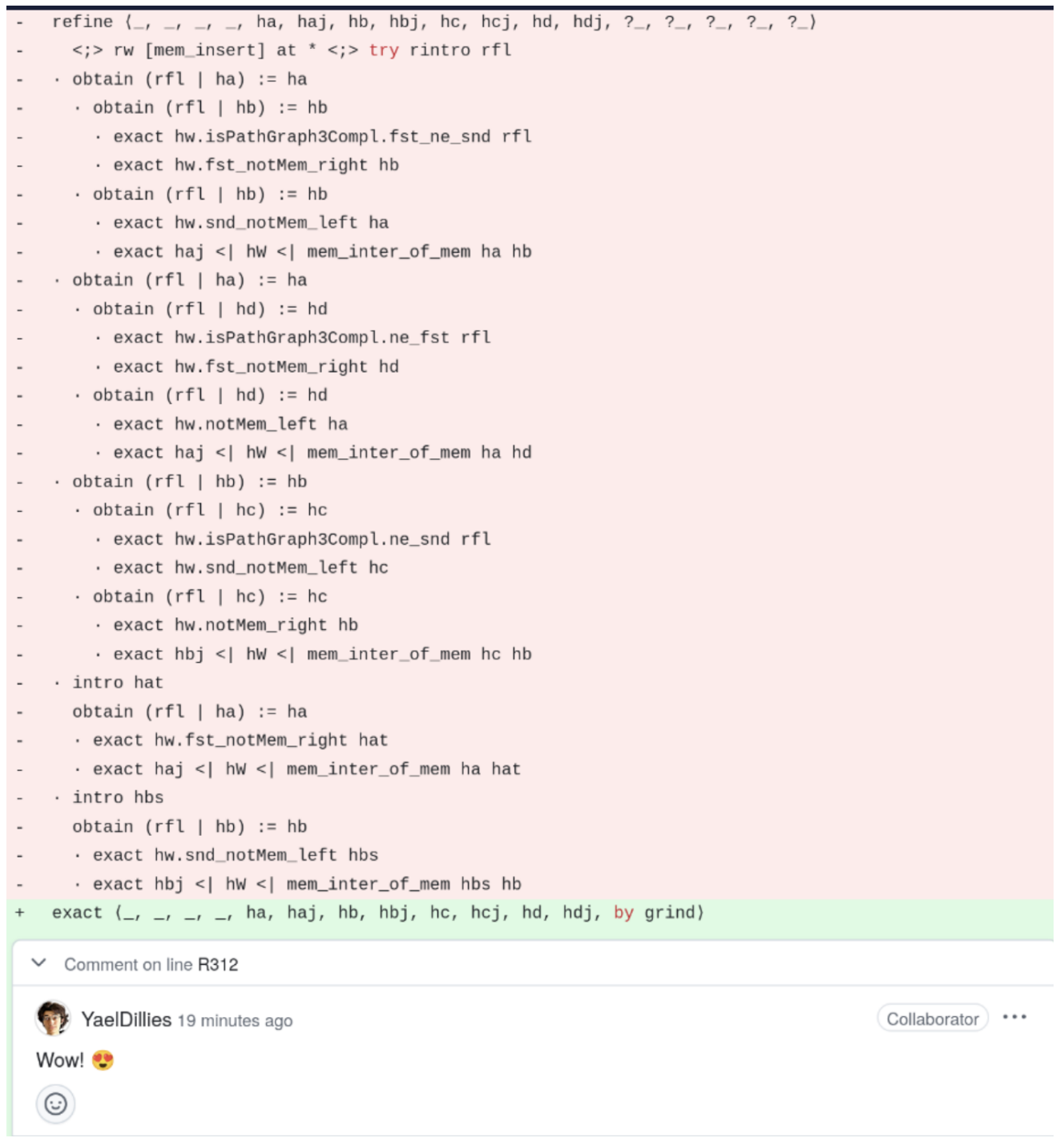
What Is grind?
New proof automation, shipped in Lean 4.22, by Leonardo de Moura and Kim Morrison
A virtual whiteboard, inspired by modern SMT solvers
-
Writes facts on the board. Merges equivalent terms
-
Cooperating engines: congruence closure, E-matching, constraint propagation, guided case analysis
-
Satellite theory solvers: cutsat (linear integer arithmetic), commutative rings (Gröbner), linarith, AC
-
Native to dependent type theory. No translation to FOL
-
Produces ordinary Lean proof terms. Kernel-checkable
VC Generation
A VC generator turns code and specifications into proof obligations
Lean-based VC generators:
-
Aeneas — Rust verification via translation to Lean
-
Velvet — a Dafny-style verifier built in Lean
-
mvcgen — Lean's VC generator for monadic programs
Issue: Verification condition generation with proof assistants has not scaled so far
Adam Chlipala's group documented this for Rocq. The same story holds in Lean
Kraken (Google): x64 Semantics in Lean
Kraken is an x64 model written in Lean
Intended for verifying sequential software that performs computations using common registers and memory
Project started after the Lean@Google Hackathon in December 2025
Andres' Challenge
Andres Erbsen (Google ISE Formal, Rocq software verification veteran)
Andres distilled the scaling problem into a minimal challenge
A small deeply embedded imperative language
inductive Cmd where
  | skip : Cmd
  | set : String → Expr → Cmd
  | seq : Cmd → Cmd → Cmd
  | input : String → Cmd
  -- .

abbrev Memory       := PartialMap Word Byte
abbrev LocalContext := PartialMap String Word
Andres' Challenge — Operational Semantics
inductive IOEvent
| IN : Word → IOEvent
| OUT : Word → IOEvent
abbrev Post := List IOEvent → Memory → LocalContext → Prop
inductive Exec : Cmd → List IOEvent → Memory → LocalContext → Post → Prop
| skip : post es m l → Exec .skip es m l post
| seq : Exec c1 es m l mid →
(∀ es' m' l', mid es' m' l' → Exec c2 es' m' l' post) →
Exec (.seq c1 c2) es m l post
| set : (h_eval : Expr.eval m l e = some v) →
(h_post : post es m (PartialMap.put l x v)) →
Exec (.set x e) es m l post
| input : (∀ v, post (IOEvent.IN v :: es) m (PartialMap.put l x v)) →
Exec (.input x) es m l post
-- .
theorem Exec.seq_cps (c1 c2 : Cmd) (es : List IOEvent)
(m : Memory) (l : LocalContext) (post : Post)
: Exec c1 es m l (fun es' m' l' => Exec c2 es' m' l' post) →
Exec (.seq c1 c2) es m l post := by
intro h; apply Exec.seq; apply h; intros; assumption
Andres' Challenge — A Parametric Program
notation:130 a " ;;\n" b => Cmd.seq a b
notation:150 x " ::= " e:150 => Cmd.set x e
notation:160 a " +' " b:160 => Expr.op Binop.add (Expr.var a) (Expr.var b)
notation:160 a " -' " b:160 => Expr.op Binop.sub (Expr.var a) (Expr.var b)

/-
Generates a command sequence of the form
input b
a := b
a := a + a; a := a - b
..
a := a + a; a := a - b
-/
def generated_cmd (n : Nat) (a b : String) : Cmd :=
  .input b ;;
  a ::= .var b ;;
  repeated_cmds n a b

abbrev spec (m : Memory) : Post := fun es m' l =>
  m' = m ∧ ∃ v : Word, es = [IOEvent.IN v] ∧ l.get "a" = some v

def Goal (n : Nat) : Prop :=
  ∀ m l, Exec (generated_cmd n "a" "b") [] m l (spec m)
Andres' Challenge — Baseline
example : Goal 1 := by
intro m l; simp only [generated_cmd, repeated_cmds]; unfold spec
apply Exec.seq_cps; apply Exec.input; intro v
apply Exec.seq_cps; apply Exec.set; simp_vc; rfl
apply Exec.seq_cps; apply Exec.set; simp_vc; rfl
apply Exec.seq_cps; apply Exec.set; simp_vc; rfl
apply Exec.skip
simp only [List.cons.injEq, IOEvent.IN.injEq, and_true, PartialMap.put_put,
PartialMap.get_put, Option.some.injEq, and_self, exists_eq']
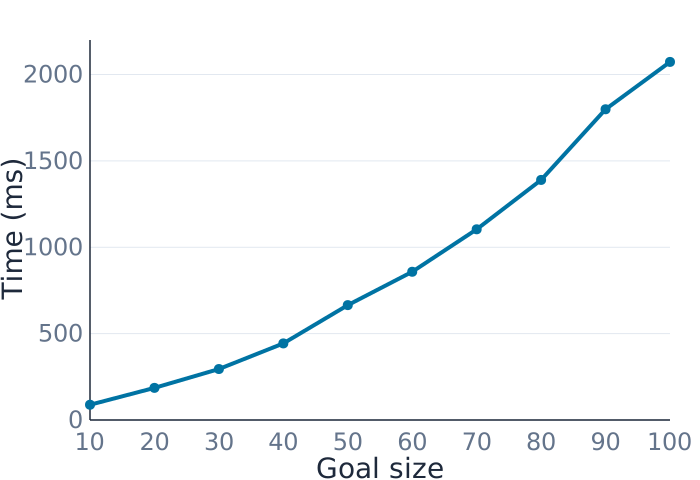
With Lean's default tactic framework, MetaM, this is superlinear
What Must Be Fast in VC Generation
The recipe is the same independent of the specific generator:
-
Efficient
apply -
Preserve term sharing
-
Reuse
simp/grinddata across VCs and across simulation steps -
...
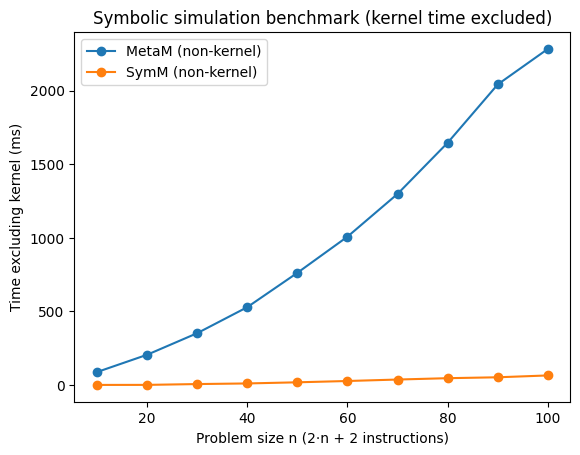
SymM: Making Verification Scale
-
SymM: new monadic framework for high-performance software verification. Born after the Lean@Google Hackathon -
Designed for tools like Aeneas, mvcgen and Velvet that need to discharge thousands of verification conditions efficiently
Without this, verifying something as large as Signal would be too slow and painful
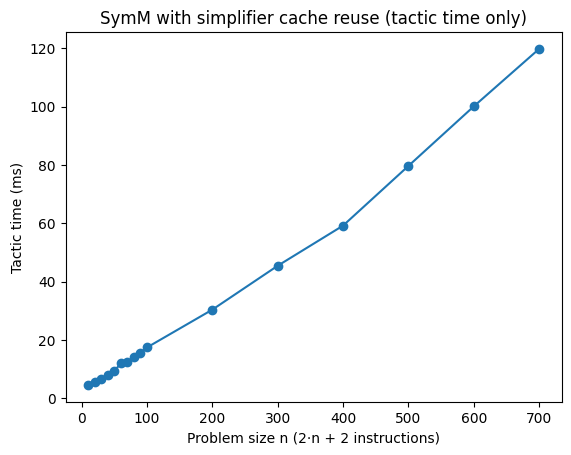
mvcgen — Ported to SymM
Andres' challenge using Lean monadic code. Linear out to n=1000
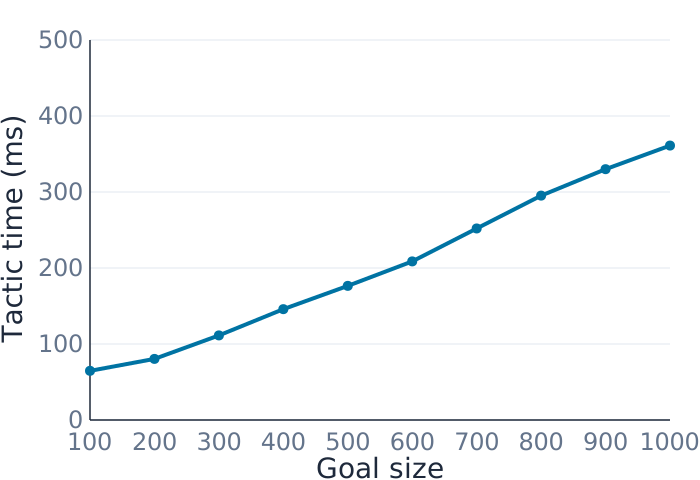
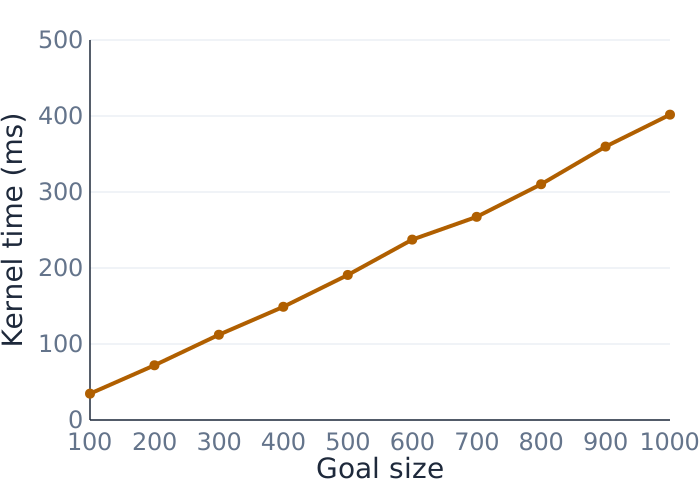
Velvet — Ported to SymM
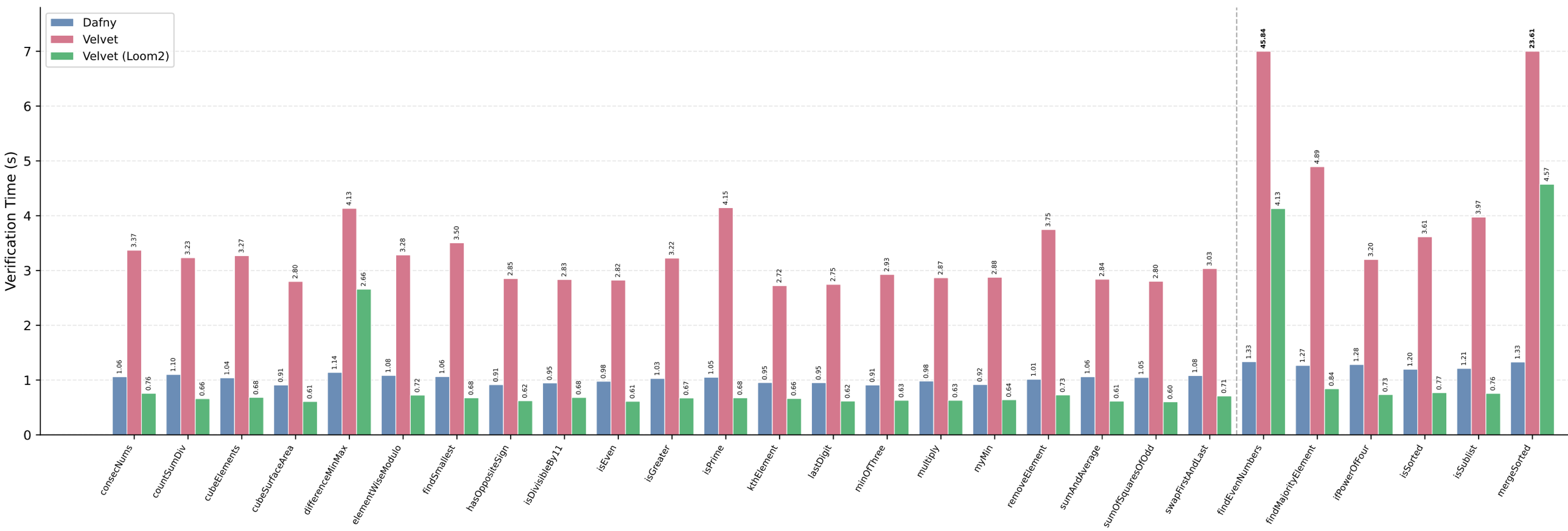
A Dafny-style verifier in Lean. Ported to SymM by Vova (Lean FRO intern). Preliminary results
-
Before: Velvet ran ~3× slower than Dafny
-
After: Faster than Dafny on 24 of 27 benchmarks; competitive on the other 3
One port beat Dafny on 24 of 27. Dafny has a vast TCB
The Lean Focused Research Organization (FRO)
Launched in August 2023 by Leonardo de Moura and me as a non-profit
A nonprofit employing 20 engineers producing open-source software
Conclusion
ITP-based verification provides highest assurances, in mathematics as in industry
"Generative AI" is not enough, "classical" AI and general scalability is as important
Program verification can require foundational framework changes to scale